Inside the Production is STOM’s editorial series exploring the thinking behind commercial filmmaking. Each edition unpacks the creative decisions, production challenges, and strategic thinking behind the campaigns we create — from the first brief to the final frame. (Approx. 8 min read.)
The Brief
Every memorable campaign begins with one idea simple enough to survive everything that follows.
Some projects begin with months of planning. This one began with a phone call.
On 2nd January 2026, while the STOM team was travelling through South Africa, we received a call from the Red Taxi team. The brief was refreshingly simple.
"We're launching Auto and Bike. We need a 30-second television commercial."
The conversation quickly moved beyond an introduction. We began engaging with the brief immediately, discussing the opportunity with the client and laying the groundwork for what would become the campaign.
On paper, it sounded straightforward.
In reality, it presented a much bigger challenge.
The mobility space is crowded with brands that all promise convenience, availability and speed. We were clear that we shouldn't create another functional advertisement that looked or sounded like every other campaign in the category.
That immediately shifted the conversation. The challenge wasn't simply to introduce two new services. It was to create something people would remember.
The One-Line Strategy
For several days, our Producer and Writer, Mahesh Karunakara and the creative team kept returning to the same question: If this project had to be described in just one sentence, what would that sentence be?
Around the same time, we started discussing about the power of a one-line brief. The idea stayed with us—not because it simplified the work, but because it demanded absolute clarity.
Instead of asking, "How do we launch Auto and Bike?" we began asking a different question.
If we had to hand this project to another writer in a single sentence, what would that sentence be?
The answer came before the script.
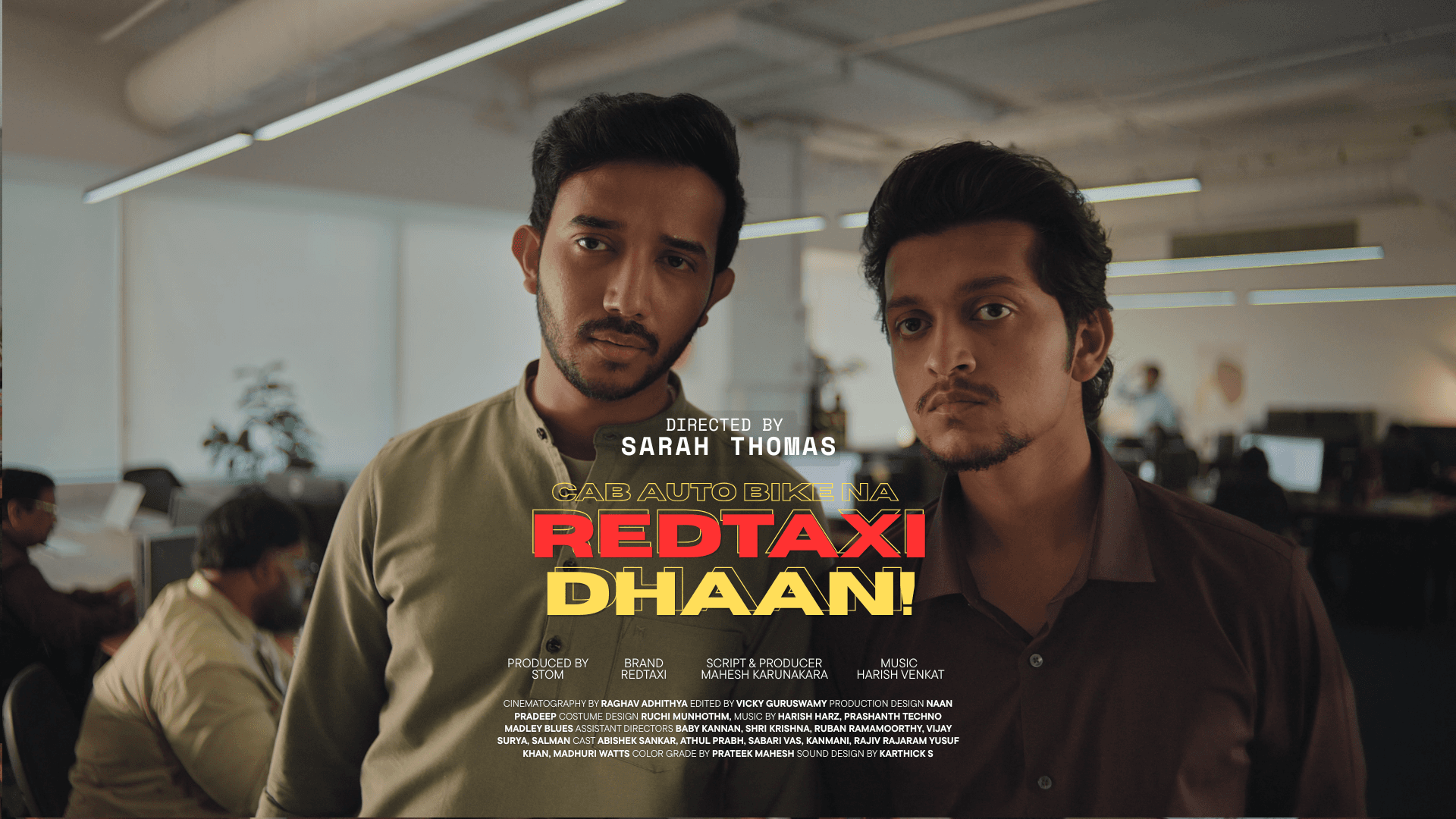
"Cab. Auto. Bike-na... Red Taxi-dhaan."
It wasn't a tagline. It was the strategy.
Building the Rhythm
Everything that followed—the screenplay, the music, the performances and ultimately the film itself—would exist for one purpose: To make that line unforgettable.
Under the creative direction of Sarah Thomas, the strategy evolved into a film where music, rhythm and repetition became the foundation of the storytelling.
Before discussing camera movements, performances or shot divisions, our Director, Sarah and Music Director, Harish Venkat spent time exploring how the campaign should sound. Not just the melody but the rhythm, the energy, the feeling.
The Director wanted the line to feel less like dialogue and more like something people would instinctively repeat. She was keen on everyday sounds in the office to be part of the rhythm, allowing the workplace itself to become an instrument within the campaign. The sounds of an office found their way into the composition. The tap of keyboards, printers, office ambience. That first music session evolved into a scratch track, which was paired with storyboards and presented to the client long before production began.
For us, the music wasn't supporting the visuals. The visuals would eventually support the music.
Finding the Right World
Interestingly, the story didn't always take place in an IT office. Our earliest concept was set inside an open marketplace. While the humour worked, it didn't feel contemporary enough for the brand. So instead of asking where the story could happen, we asked where Red Taxi naturally fits into people's lives.
The answer was obvious. IT parks.
Long meetings.
Late evenings.
People trying to get home after work.
It wasn't simply a better location. It was a more truthful one.
Invisible Production Challenges
From there, the production presented its own set of challenges. Creating the feeling of a bustling corporate office without an unlimited number of extras meant every available pair of hands stepped in. Members of our own crew quietly became office employees in the background. Departments disappeared into the frame as colleagues, managers and passers-by. The audience will never know who belonged to the production team and who was cast for the film. And that's exactly how it should be.
Another challenge arrived as daylight disappeared. The story unfolds over roughly an hour, but the production lasted an entire day. By the time we reached the later scenes, it was already dark outside. Because we couldn't rig large lighting setups on the road outside the office, we carefully controlled the interior environment and later relied on post-production to preserve the feeling of a continuous afternoon.
It's the kind of invisible problem-solving that rarely gets noticed—but filmmaking is often built on decisions the audience should never have to think about.
The Power of Repetition
Creatively, one principle guided every scene.
Repetition.
Not repetition for the sake of branding, but repetition with personality.
Every character delivers the line differently. A boss says it with authority. A colleague says it casually. A friend says it with familiarity. Each variation reflects the way people naturally speak while reinforcing exactly the same thought. The humour comes from the reactions. The branding comes from the repetition.
Together, they become inseparable.
The First Sign It Was Working
One of our favourite moments happened long before the commercial reached television. Between takes, as the scratch track played repeatedly on set, people began singing it. No one was rehearsing. It simply started happening. Crew members, artists and technicians.
The line had quietly escaped the script and entered conversation. For us, that was the first sign the campaign might work.
Today, the film continues to run across television and digital platforms. Looking back, what stays with us isn't just the campaign itself. It's the reminder that memorable advertising doesn't always begin with a bigger production or a bigger budget. Sometimes it begins by reducing an entire brief to a single sentence that people can't help repeating.
______________________________________________________
What We Learned
The strongest campaigns don't always explain the most.
They identify the one thought worth remembering and build everything around it. For Red Taxi, the commercial wasn't designed to tell people the brand now offers cabs, autos and bikes. It was designed so that the next time someone thought about booking any of those, Red Taxi would be the first name that came to mind.
Follow the series as we continue documenting the ideas that shape every production.